
What Is Multi-Model API Routing?
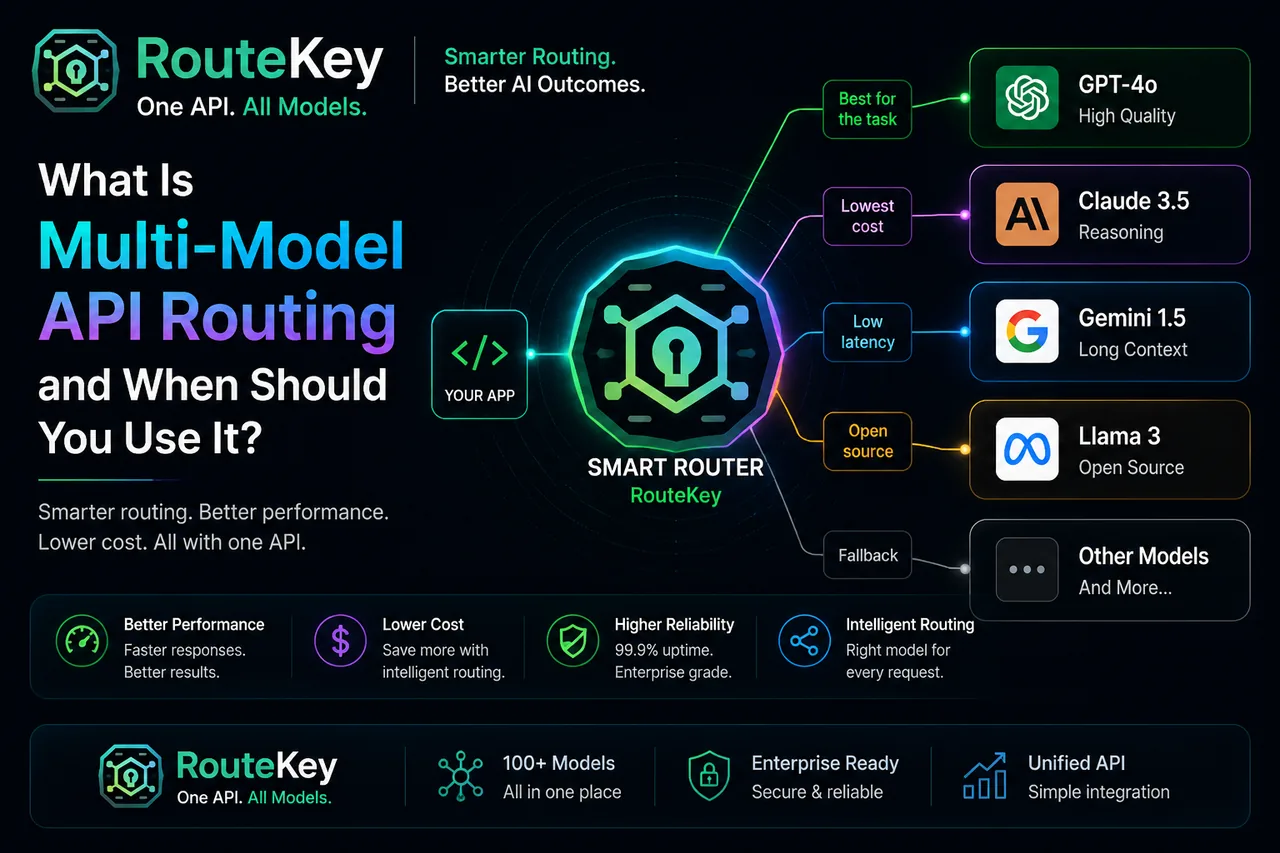
Multi-model API routing sends requests through one compatible gateway and chooses a model or provider channel using a policy. The policy can consider task type, price, health, latency, context window, or feature support. Instead of hard-coding one provider in every application, a team keeps a stable API surface and changes routing behind it.
Why teams route across models
One model is rarely best for every workload. A compact model may handle classification and extraction at a lower cost, while a larger reasoning model is better for complex planning or code. A second provider can also provide capacity when the primary route is slow or unavailable.
Routing is useful when an application has different task classes, variable traffic, or a need for failover. It adds policy decisions, so it should be introduced with clear observability rather than hidden behind an unexplained alias.
Common routing policies
Cost-aware routing selects an eligible lower-cost route when quality and feature requirements are satisfied. Capability routing sends coding, vision, or long-context tasks to models that support those features. Health routing avoids a channel with elevated error rate or latency. A fallback policy retries an eligible alternative when the first route fails.
Start with one simple policy and document why each route is eligible. Avoid a policy that changes model and prompt format at the same time because debugging becomes difficult.
Define eligibility before price
Price should be evaluated after capability. Check context length, tool calling, structured output, streaming, image or audio support, rate limits, and model availability for the account group. A cheap model that cannot complete the task is not an eligible route.
The Route Key Models catalog helps compare model families, endpoints, billing groups, and price signals before you write a policy. Copy the exact enabled model ID into configuration.
Keep the request shape stable
An OpenAI-compatible gateway lets clients keep their SDK and message structure while the routing policy changes behind the base URL. This reduces migration work and makes a route experiment reversible. You still need to test endpoint-specific behavior, especially tools, streaming, and multimodal content.
The integration guide shows how to create a key, set the base URL, and send a first request. Use the developer docs for request examples and compatibility notes.
Measure cost per successful task
Track input and output tokens, cache tokens, latency, retries, error rate, and human review. Compare cost per successful task rather than cost per request. A fallback that runs twice can be more expensive than a stable primary route even when each individual model is inexpensive.
Inspect Usage Logs after every routing change. Keep a dated sample set so quality and cost changes can be compared over time.
Design a safe fallback
Choose a fallback with a compatible endpoint and enough capacity. Limit retries, use backoff, and avoid sending a request to a second model when the first response has already been accepted. For state-changing tool calls, confirm whether a retry could duplicate an action before enabling automatic failover.
A simple routing architecture
The client sends one compatible request to the gateway. The gateway authenticates the key, validates the endpoint, evaluates eligible routes, and sends the request to a selected model or channel. The response returns through the same API surface while Usage Logs record the model, tokens, cost, latency, and status.
Keep policy configuration separate from application prompts. A task label or explicit model selection can express intent, while the gateway owns health and channel decisions. This boundary lets platform teams update a route without forcing every application team to release new code.
When not to add routing
If an application has a small, stable workload and one model already meets its cost and reliability targets, extra policy may not be worth the operational complexity. Routing also cannot repair a poor prompt, missing evaluation set, or unsafe retry behavior. Establish a baseline and a reason for the second route before adding it.
Do not route solely on the lowest price if outputs have legal, financial, or high-impact consequences. Use an approved model set, quality checks, and human review appropriate to the task. The goal is controlled choice, not unpredictable model switching.
Roll out the policy in stages
Test the alternative offline, then with internal traffic, then with a small production share. Define maximum error rate, latency, and cost per successful task. Increase the share only when all thresholds pass, and keep a fast path back to the previous policy.
FAQ
Is multi-model routing the same as load balancing?
No. Load balancing spreads traffic, while model routing can select different capabilities, prices, and fallback behavior for each task. A system can use both.
Does routing hide which model answered?
It should not. Record the selected model, endpoint, and route decision in Usage Logs so support and cost reviews can reproduce the result.
What is the best first experiment?
Keep one default route and send a small, well-defined task class to one alternative. Compare quality, latency, retries, and cost before expanding the policy.