
GPT-6 Astra vs Fable 5.1 vs Gemini 3.8 Flash
Quick answer
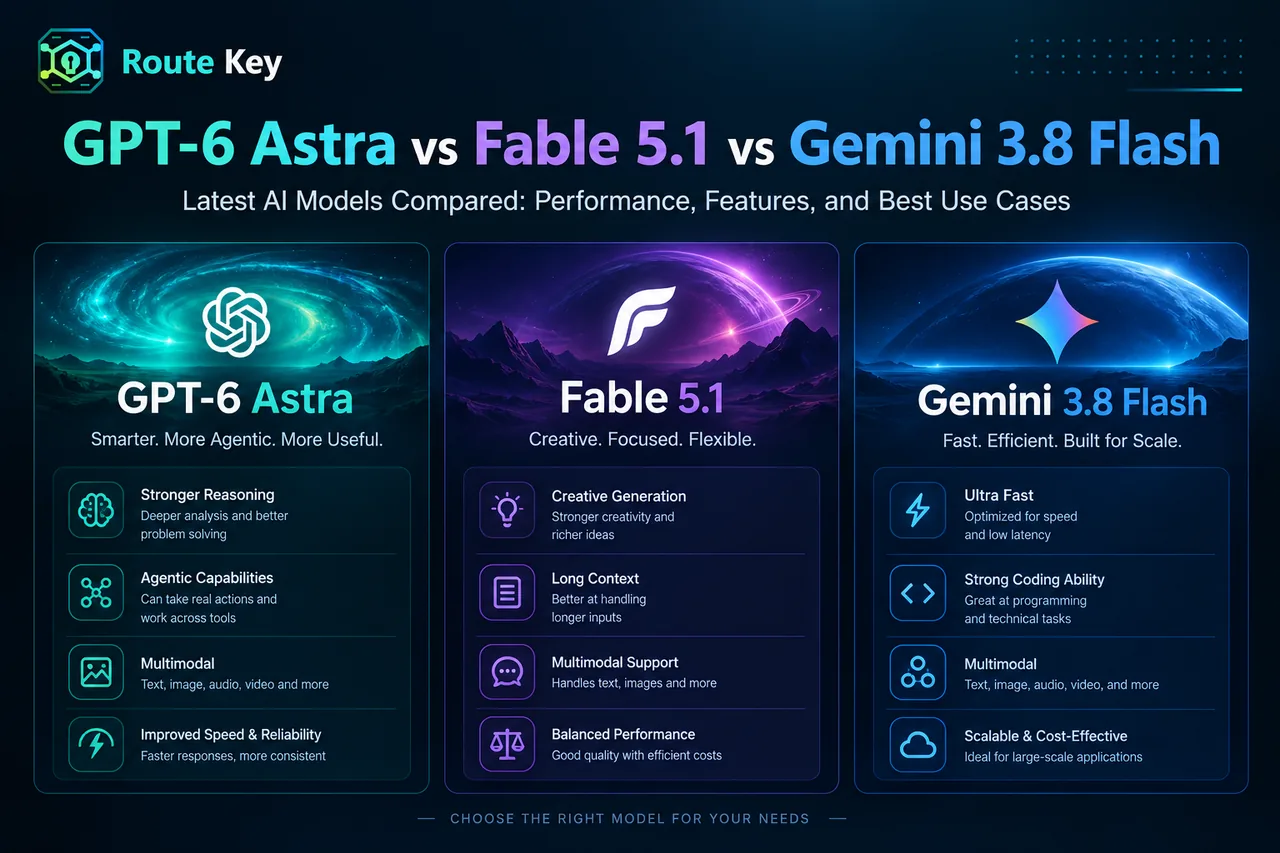
There is no responsible universal winner between GPT-6 Astra, Claude Fable 5.1, and Gemini 3.8 Flash.
- GPT-6 Astra is the strongest candidate when the workload depends on frontier computer use, complex coding, cybersecurity, or scientific work and the organization can support strict agent governance.
- Claude Fable 5.1 is the clearest candidate for long-running coding and knowledge work where sustained execution, root-cause fixes, cache economics, and progress communication matter.
- Gemini 3.8 Flash is the most natural candidate for latency-sensitive, high-volume, retrieval, or interactive work where configurable thinking can balance speed and reasoning.
These are deployment hypotheses based on the vendors' official positioning, not a benchmark result. A technical manager should choose a portfolio and routing policy before choosing a single winner.
Sources and public product information were checked on September 7, 2026.
Evidence snapshot
| Dimension | GPT-6 Astra | Claude Fable 5.1 | Gemini 3.8 Flash |
|---|---|---|---|
| Official signal | OpenAI announcement and safety overview | Anthropic announcement and model docs | Google Gemini API code example and tool support docs |
| Vendor positioning | Frontier computer use, coding, cybersecurity, science | Most capable GA model for coding and knowledge work | Flash model with configurable thinking and File Search support |
| Most interesting engineering question | Can it complete long agent trajectories safely? | Does sustained work reduce repair loops and total cost? | Which thinking level clears quality targets at the best latency? |
| Published price used here | Verify current API/catalog | $10 input, $50 output, $0.25 cache read per 1M tokens | Verify current API/catalog |
| Principal adoption risk | High-capability tools with excessive permissions | Paying frontier rates where a smaller model is sufficient | Treating the Flash label as proof of workload speed or quality |
The empty price cells are deliberate. A comparison should not fill missing current facts with copied screenshots, launch rumors, or a different provider's billing unit.
Three models, three product philosophies
Astra: make the computer part of the model loop
OpenAI's Astra announcement emphasizes computer use alongside coding, cybersecurity, and science. The strategic idea is broader than tool calling: the model can work through software interfaces and carry a task across multiple systems.
That can remove integration friction, but it also moves risk from generated text into real actions. Astra's value rises with task complexity; so does the need for isolation, approval gates, credential scoping, trace retention, and stop conditions.
Fable 5.1: sustain difficult work without shallow shortcuts
Anthropic frames Fable 5.1 around ambitious coding and knowledge projects, root-cause resolution, research, and long-running execution. Its unusually low cache-read price also targets agents that repeatedly reuse large stable contexts.
The central question is whether the model's longer attention to a problem produces fewer repair turns. That cannot be inferred from token price. It must be measured through accepted patches, reviewer edits, and completed workflows.
Gemini 3.8 Flash: tune the reasoning-latency trade-off
Google's documented thinking_level control suggests a product design where teams can vary effort inside a responsive model family. That is attractive for applications with a wide difficulty distribution: most requests are easy, but a meaningful minority need planning.
The engineering challenge is routing. If every request receives the highest thinking level, the team may lose the latency advantage. If difficult requests stay at a lower level, repair cost can erase the savings.
Which model should lead each workload?
| Workload | First model to test | Why | Required counter-test |
|---|---|---|---|
| Browser-based operations | GPT-6 Astra | Computer use is central to official positioning | Permission safety, injection resistance, intervention rate |
| Large repository change | Fable 5.1 and Astra | Both emphasize difficult coding and long tasks | Accepted patches, unrelated changes, test completion |
| Document research | Fable 5.1 | Knowledge work and research are central claims | Citation accuracy, missing evidence, cache hit rate |
| High-volume support | Gemini 3.8 Flash | Latency-sensitive Flash positioning | Grounding, escalation accuracy, tail latency |
| Retrieval assistant | Gemini 3.8 Flash | Official File Search support | Retrieval relevance and citation faithfulness |
| Defensive security | Astra under isolation | OpenAI discloses Critical cyber capability | Governance, boundaries, unsafe-action attempts |
| Routine extraction | Smallest model that passes | Frontier models may be unnecessary | Schema validity and retry-adjusted cost |
The table identifies where to start testing, not where to finish buying.
Compare cost per accepted task
Token price is only one variable:
accepted task cost = model usage + tool usage + retries + fallback calls + reviewer time
Fable 5.1 publishes clear list prices and a significant cache-read discount. That can be excellent for stable, repeated context. Gemini Flash may offer a latency and volume advantage, but the current price and thinking-token treatment must be checked. Astra may justify a frontier price when it replaces many manual steps, but a costly failed trajectory can reverse the economics.
For every test run, log:
- exact model ID or snapshot;
- endpoint and region;
- input, output, reasoning, cache-write, and cache-read usage when available;
- time to first token and end-to-end latency;
- tool calls, retries, and fallback model calls;
- human review minutes;
- final accepted or rejected outcome.
Then calculate cost by task class, not as one blended average.
Security may decide before quality does
The three models can be exposed through tools, retrieval, and application APIs, but their risk profiles depend on the system around them.
GPT-6 Astra needs special attention because OpenAI says it meets the Critical cybersecurity capability threshold. Fable 5.1 introduces an explicit relationship between the generally available model and the more restricted Mythos safeguard tier. Gemini 3.8 Flash can participate in retrieval and agent flows where untrusted documents may influence tool use.
Use one common governance layer:
- Least-privilege credentials and allowlisted tools.
- Read-only defaults and approval for consequential writes.
- Separation between user content, retrieved content, and system policy.
- Validation of tool arguments outside the model.
- Full traces with secret and personal-data redaction.
- Per-model rate, time, step, and spend limits.
- A tested fallback and emergency-disable path.
Model intelligence is not a substitute for application controls.
A portfolio beats a permanent winner
Most teams should not route everything to one frontier model. A practical stack has at least three roles:
- Default route: the lowest-cost, lowest-latency model that clears normal quality targets.
- Complex route: a stronger model for high-ambiguity, long-context, or multi-step work.
- Specialist route: a model selected for computer use, retrieval, coding, or another measured strength.
One reasonable starting experiment is Gemini 3.8 Flash for frequent interactive work, Fable 5.1 for long coding and research tasks, and GPT-6 Astra for tightly governed computer-use or frontier workflows. The resulting data may reverse that arrangement. That is the point of the experiment.
Route Key's multi-model catalog and OpenAI-compatible integration guide let applications keep the model decision configurable instead of embedding one provider throughout business logic.
A fair evaluation design
Create 30 to 100 tasks from recent, representative work. Remove sensitive data, preserve the difficulty distribution, and include cases where the correct action is to ask for clarification or stop.
Score every run on four layers:
| Layer | Metrics |
|---|---|
| Outcome | Accepted result, correctness, completeness |
| Process | Tool precision, recovery, verification, intervention |
| Operations | p50/p95 latency, errors, capacity, retries |
| Economics | Tokens, tools, fallback, reviewer time, cost per accepted task |
Run the same prompt and tools first. Tune each model only after the baseline. Use blinded reviewers where practical, and retain traces so failures can be classified rather than argued from memory.
Editorial verdict
GPT-6 Astra looks like the most consequential release for organizations ready to let a model operate real software. Fable 5.1 presents the most legible business case for long-horizon coding and knowledge work, especially when prompt caching is already effective. Gemini 3.8 Flash may be the most useful everyday default if its thinking controls deliver the expected balance of responsiveness and task quality.
None should be adopted on reputation alone. The winning model is the one that meets a written quality threshold, stays inside the organization's control boundary, and lowers the total cost of an accepted outcome.
FAQ
Which model is best for coding?
Test Astra and Fable 5.1 first for difficult repository work, then include Gemini 3.8 Flash at the appropriate thinking level. Measure accepted patches, test results, repair turns, unrelated edits, latency, and reviewer time.
Which model is fastest?
No name or vendor claim answers this for your traffic. Measure time to first token and end-to-end p50/p95 latency with the same prompt, tools, region, concurrency, and output length.
Which model is cheapest?
Fable 5.1 has explicit prices in this comparison, but the cheapest list price is not automatically the lowest task cost. Check current Astra and Gemini pricing and include cache, retries, tools, and human review.
Should we use one model provider?
A single provider simplifies procurement and operations, but increases model, quota, and outage concentration. A thin model adapter plus evaluated fallback routes usually provides better resilience.
How often should the comparison be updated?
Re-run the task set when a model ID, snapshot, endpoint, pricing rule, safeguard, or tool interface changes. Review rolling aliases more frequently because behavior can change without an application code change.
Sources and model deep dives
- OpenAI, GPT-6 Astra announcement and safety overview.
- Anthropic, Claude Fable 5.1 announcement.
- Google AI for Developers, Gemini 3.8 Flash generation guide.
- Route Key, GPT-6 Astra technical review.
- Route Key, Claude Fable 5.1 engineering review.
- Route Key, Gemini 3.8 Flash production review.
- Route Key, what is multi-model API routing?.