
MCP vs Agent Skills: Capability, Token Cost, and Integration Trade-offs
Abstract
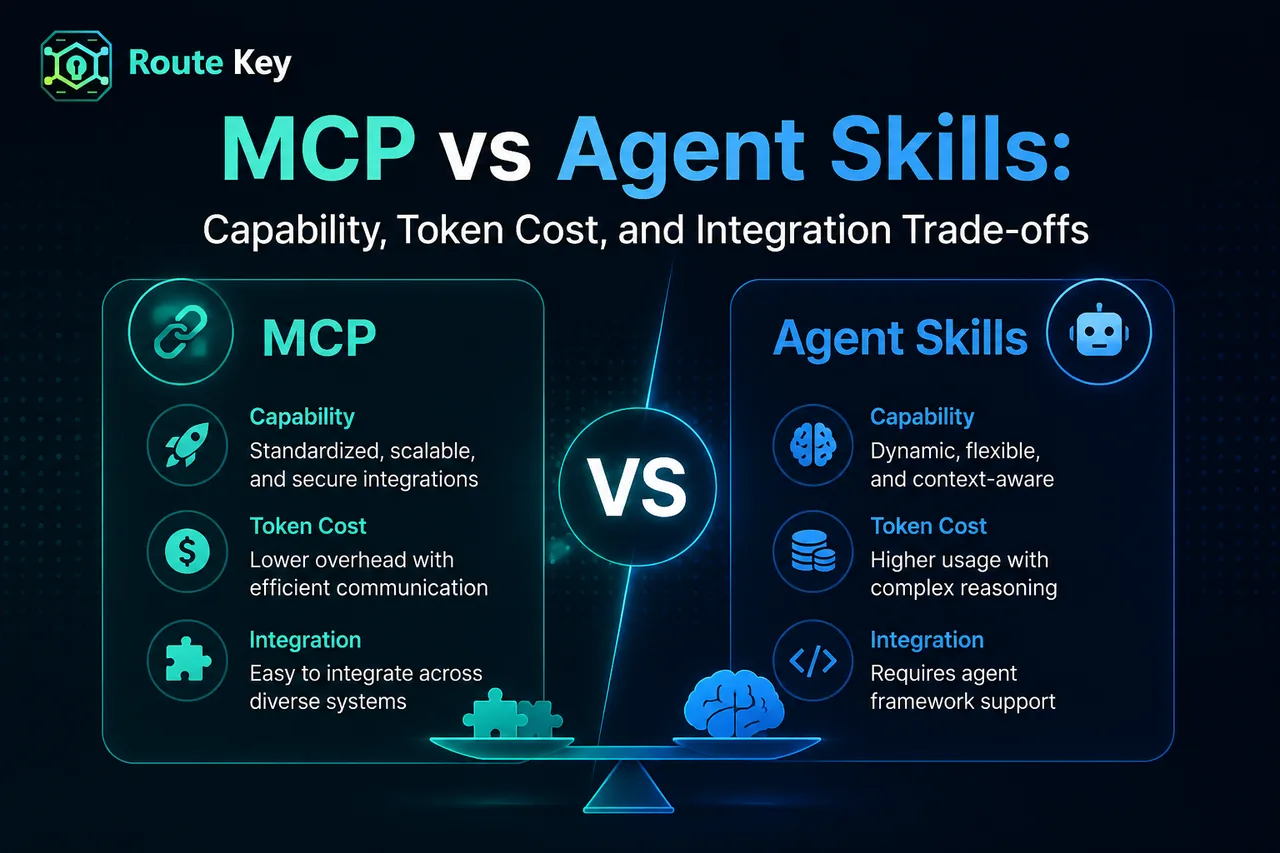
Model Context Protocol (MCP) and Agent Skills are often described as competing ways to extend an AI agent. That framing is convenient, but incomplete. MCP is primarily a protocol for connecting an agent to live data, tools, and controlled actions. A Skill is primarily a portable package of instructions, references, scripts, and assets that teaches an agent how to complete a repeatable workflow.
Neither approach changes the model's weights or raises its underlying intelligence. They improve effective capability in different ways. Skills add procedural knowledge: what steps to follow, which rules matter, and what a good result looks like. MCP adds environmental capability: what the agent can retrieve, observe, or change at runtime.
This article compares the two approaches across model capability, token consumption, integration effort, authoring difficulty, latency, reliability, security, portability, and maintenance. It also proposes a practical evaluation method for teams choosing between a Skill, an MCP server, or a combined architecture.
Definitions and scope
The Model Context Protocol is an open protocol for exposing tools, resources, and related context to AI applications. An MCP client can discover capabilities from a server, send structured requests, and receive structured results. Depending on the host and server, the connection may run locally through standard input/output or remotely over HTTP.
Agent Skills are reusable capability packages built around instructions and optional supporting resources. A typical Skill contains a SKILL.md file with a name, a description, and a workflow. It may also include references, templates, examples, deterministic scripts, or other assets. Claude, Codex, and other agent hosts may differ in discovery paths and metadata, but the broader pattern is the same: load compact metadata first, then bring detailed workflow knowledge into context when relevant.
This comparison uses Skill as the general category, not as a feature belonging to one vendor. Claude Skills, Codex Skills, and implementations based on the open Agent Skills specification are examples of the same architectural family.
The shortest useful distinction
| Question | Agent Skill | MCP |
|---|---|---|
| What does it primarily add? | Procedures, domain guidance, examples, templates, and reusable workflow logic | Live data, external tools, authenticated services, and controlled actions |
| Where does the capability live? | Files and packaged resources loaded into the agent context or executed by the host | A local or remote server with a structured protocol boundary |
| Does it require a running service? | Usually no | Usually yes, although a local process can be started on demand |
| Can it work offline? | Often, if its references and scripts are local | A local MCP server can; a remote data source usually cannot |
| Best at | Teaching the agent how to do a task | Giving the agent something it can query or operate |
| Typical example | A release-review workflow with a checklist and report template | A GitHub server that reads pull requests and posts review comments |
A Skill can tell an agent how to review an incident. MCP can retrieve the incident, query logs, and update the ticket. A production-grade incident workflow often needs both.
How each approach improves effective model capability
Skills improve procedural capability
A strong Skill reduces ambiguity around a repeatable task. It can define the required inputs, decision points, tool order, output structure, safety constraints, and stop conditions. This is especially valuable when a capable general model still produces inconsistent results because organizational knowledge is missing or the workflow is underspecified.
Skills are effective for:
- applying an internal writing, review, or design standard;
- turning a long operating procedure into a repeatable workflow;
- selecting among existing tools and calling them in a safe order;
- providing domain examples, schemas, rubrics, and templates;
- running deterministic local scripts for conversion, validation, or calculation;
- keeping large reference material available without placing all of it in every prompt.
The limitation is important: instructions cannot create access that the host does not have. A Skill may explain how to read a private CRM record, but without an authorized tool or connector it cannot retrieve the record. A script bundled with a Skill can add deterministic computation only when the host allows that script to run.
MCP improves information and action capability
MCP expands what an agent can observe and do. A server can expose current documentation, database records, browser state, design files, logs, repository operations, or business actions through structured tools and resources. This can turn a text-only model into an agent that works against the current state of a real system.
MCP is effective for:
- retrieving frequently changing or private information;
- executing authenticated operations against external services;
- centralizing authorization, validation, rate limits, and audit controls;
- exposing structured tool inputs instead of relying on natural-language parsing;
- serving the same integration to multiple compatible AI clients;
- keeping sensitive credentials and business logic outside the model prompt.
MCP does not, by itself, teach the model the best business workflow. A server with forty well-designed tools may still produce poor outcomes if the agent does not know which tool to call first, how to interpret incomplete data, or when to ask for approval. Tool availability is not the same as workflow competence.
Capability comparison by task type
| Required improvement | Skill contribution | MCP contribution | Preferred approach |
|---|---|---|---|
| Follow a house style or review rubric | High | Low | Skill |
| Use current private data | Low without another tool | High | MCP |
| Perform an authenticated write action | Low without another tool | High | MCP |
| Reuse a stable multi-step procedure | High | Medium if encoded in server logic | Skill, or Skill + MCP |
| Perform deterministic local processing | Medium to high with scripts | High with a purpose-built tool | Depends on deployment needs |
| Coordinate several external systems | High for orchestration guidance | High for system access | Skill + MCP |
| Improve raw reasoning on an unfamiliar problem | Limited | Limited | Better model, better prompt, or targeted context |
Token consumption: where the cost actually comes from
There is no universal claim that “Skills use fewer tokens” or “MCP is more token efficient.” Token cost depends on discovery metadata, loaded instructions, tool schemas, tool results, repeated calls, caching behavior, and the host's implementation.
A useful conceptual model for an activated Skill is:
T_skill = T_discovery
        + T_instructions
        + T_selected_references
        + T_script_results
For an MCP-assisted task:
T_mcp = T_tool_discovery
      + T_selected_schemas
      + sum(T_arguments + T_results + T_follow_up_reasoning)
These equations describe context consumption, not a provider's exact billing formula. Some hosts cache repeated prefixes, defer tool discovery, summarize results, or account for tool traffic differently.
Skill token profile
Skills can be efficient because of progressive disclosure. The host can initially expose only the Skill name and description, load the full instructions after activation, and read supporting references only when needed. A well-structured Skill therefore avoids pasting a complete manual into every user request.
However, a Skill becomes expensive when:
- its
SKILL.mdis a monolithic handbook rather than a focused workflow; - it loads every reference file regardless of the task;
- examples repeat the same rules in several forms;
- several Skills overlap and activate together;
- verbose script output is returned to the model instead of a compact result.
The best optimization is not simply shortening the Skill. It is separating a concise decision workflow from detailed references and loading only the branch required for the current task.
MCP token profile
MCP can reduce tokens when a targeted query replaces a large pasted document. For example, retrieving five matching records is usually more efficient than adding an entire customer database export to the prompt. Structured arguments can also reduce ambiguity and retry cost.
MCP becomes expensive when:
- a large tool catalog and every JSON schema are inserted into context upfront;
- tool descriptions are repetitive or unclear, causing selection retries;
- a server returns raw HTML, logs, or database rows without filtering;
- the agent needs several sequential round trips to assemble one answer;
- error payloads are verbose and do not tell the model how to recover;
- several servers expose overlapping tools with ambiguous names.
The most important MCP token optimization often happens on the server: filter, paginate, aggregate, and return only fields that help the model make the next decision.
Relative token-cost matrix
| Scenario | Skill token profile | MCP token profile | Likely winner |
|---|---|---|---|
| Stable checklist with no live data | Small metadata plus one workflow | Unnecessary protocol and tool overhead | Skill |
| Search a changing knowledge base | Static guidance may be stale or huge | Targeted retrieval plus selected results | MCP |
| Repeated report using live data | Workflow tokens are predictable | Tool schemas and results vary with data | Skill + MCP |
| One deterministic file conversion | Small Skill plus local script output | Local tool call can also be compact | Similar; choose simpler deployment |
| Broad server with many tools | No direct equivalent | Potentially high discovery/schema cost | Skill unless live tools are necessary |
| Large policy library with selective lookup | Efficient only with progressive loading | Retrieval server can select relevant passages | Depends on update frequency and access control |
Integration and authoring difficulty
Writing a Skill
The minimum viable Skill is a directory and a well-written SKILL.md. That makes initial integration comparatively easy: no service discovery, transport, authentication flow, or remote deployment is required. Teams can version the Skill beside a repository and review instruction changes like code.
The hard part is not file creation. It is writing instructions that activate for the right requests and still behave correctly when inputs are missing, ambiguous, or adversarial. A mature Skill needs representative tests for positive activation, negative activation, incomplete input, edge cases, tool failure, and output quality.
Authoring becomes more difficult when the Skill includes executable scripts or must support multiple hosts. File locations, invocation policy, metadata, sandbox permissions, and supported tools can differ even when the core SKILL.md is portable.
Building an MCP server
An MCP integration requires software engineering beyond prompt writing. The team must design tool and resource schemas, implement the server, choose a transport, manage credentials, validate inputs, normalize errors, enforce authorization, and observe production behavior. Remote deployments also need availability, scaling, versioning, and incident response.
The benefit is a cleaner operational boundary. Secrets stay on the server, tool inputs can be validated, business rules can be enforced before writes, and calls can be audited independently of the model conversation. For an integration that several agent clients will reuse, this investment can be more maintainable than duplicating custom tool code in every client.
Engineering effort comparison
| Dimension | Agent Skill | MCP |
|---|---|---|
| Initial setup | Low: files, metadata, and instructions | Medium to high: server, schemas, transport, and client configuration |
| Primary authoring skill | Workflow design, technical writing, prompt evaluation | API design, backend engineering, security, and operations |
| Authentication | Usually inherited from the host's existing tools | Must be designed for local credentials, bearer tokens, OAuth, or another supported model |
| Testing | Trigger tests, workflow cases, output evaluation, script tests | Protocol tests, schema tests, auth tests, tool semantics, load and failure tests |
| Deployment | Copy, install, or version a package | Run a local process or deploy and operate a remote service |
| Updates | Replace instructions or supporting files | Deploy compatible server changes and manage client/server versions |
| Observability | Often host-dependent | Can implement server-side logs, metrics, traces, and audit records |
| Cross-client portability | Core format can travel, but host behavior varies | Protocol is portable, but supported features and authorization still vary |
Advantages and disadvantages
| Approach | Advantages | Disadvantages |
|---|---|---|
| Agent Skill | Fast to start; easy to version with a project; strong for standards and repeatable procedures; supports progressive loading; can bundle references, templates, and deterministic scripts; often works without a network service | Cannot independently access live/private systems; quality depends heavily on instruction design; host-specific activation and permissions can reduce portability; large Skills can consume substantial context; bundled scripts introduce execution and supply-chain risk |
| MCP | Provides live data and real actions; centralizes credentials and business controls; supports structured schemas; reusable across compatible clients; enables server-side observability and auditing; can keep large data sources outside the prompt | Higher implementation and operating cost; tool schemas and results consume context; remote calls add latency and failure modes; authentication is non-trivial; broad permissions increase impact of mistakes; a tool catalog does not teach a good workflow |
| Skill + MCP | Combines reusable procedure with current information and controlled actions; separates workflow knowledge from infrastructure; can produce the largest practical capability gain | Requires testing two interacting layers; version drift can break tool sequences; total context and latency can grow; ownership must be clear across Skill authors and server operators |
Latency, reliability, and security
A local instruction-only Skill normally adds little runtime latency beyond reading and reasoning over its content. A Skill that invokes scripts or several tools can still be slow. MCP latency includes server startup or network time, authentication, downstream APIs, retries, and each model-tool round trip.
Reliability also fails differently. Skills fail semantically: the wrong Skill activates, an instruction is misunderstood, a reference is stale, or the workflow omits an edge case. MCP fails operationally: the server is unavailable, a token expires, a downstream API changes, a schema is incompatible, or a write is rejected.
Both approaches expand the attack surface:
- A malicious or poorly reviewed Skill can contain prompt injection, unsafe commands, hidden scripts, or instructions that request excessive access.
- An MCP server can expose sensitive data, overpowered write tools, weak authorization, or untrusted content returned from external sources.
- Tool output itself may contain prompt injection. Structured JSON does not make untrusted text safe.
- Combining a broad Skill with a high-privilege MCP server can turn an instruction error into a real external action.
Use least-privilege tools, explicit approval for consequential writes, narrow schemas, output limits, trusted package sources, audit logs, and separate read-only from write-capable operations. The OWASP prompt injection guidance is relevant to both packaged instructions and retrieved tool content.
A practical selection framework
Choose a Skill first when the task depends on stable knowledge and repeatable judgment:
- the agent already has all required files or tools;
- the main problem is inconsistent process or output quality;
- the workflow changes with the repository rather than with a remote service;
- low setup cost and offline use matter;
- a checklist, rubric, reference set, or deterministic local script is enough.
Choose MCP first when the task depends on current state or controlled access:
- information changes too frequently to package safely;
- the agent must read private systems or perform authenticated actions;
- authorization and auditing must be enforced outside the prompt;
- several clients need the same tool integration;
- server-side filtering can avoid sending a large dataset into context.
Choose Skill + MCP when the user goal is a business process rather than a single tool call. Examples include incident response, customer research, release management, support triage, compliance review, or analytics reporting. MCP supplies the live system boundary; the Skill supplies the repeatable method.
How to benchmark the choice
Do not compare architectures using one impressive demo. Build a small evaluation set of representative tasks and run the same model under four conditions: baseline prompt, Skill only, MCP only, and Skill + MCP. Keep model settings and task inputs constant.
| Metric | What to record | Why it matters |
|---|---|---|
| Task success rate | Objective checks plus a human rubric | Measures practical capability gain |
| Input tokens | Instructions, metadata, schemas, and retrieved context | Reveals context overhead |
| Output tokens | Final answer plus intermediate model output where available | Detects verbosity and retry cost |
| Tool-result size | Tokens or bytes returned per call | Identifies server-side filtering opportunities |
| Tool-call count | Successful calls, retries, and recovery calls | Connects cost with workflow quality |
| End-to-end latency | Median and tail latency | Captures network and multi-round-trip cost |
| Human corrections | Number and severity of edits | Measures consistency beyond token price |
| Operational failures | Timeouts, auth errors, schema errors, rejected writes | Measures production readiness |
A useful comparison is cost per successful task, not tokens per request. A shorter prompt is not cheaper if it causes retries, incorrect actions, or manual rework. Likewise, a larger Skill may be economically justified if it prevents an expensive operational mistake.
Conclusion
MCP and Agent Skills extend different dimensions of an AI system. Skills encode reusable procedural knowledge and make behavior more consistent. MCP exposes live information and controlled actions. Skills are generally easier to author and deploy; MCP requires more engineering but creates a stronger integration, security, and observability boundary.
For token efficiency, the decisive issue is selection. Skills should progressively load only the instructions and references needed for the task. MCP servers should expose focused tools and return compact, filtered results. Either approach can waste context when its capability catalog is broad, ambiguous, or eagerly loaded.
The practical rule is simple: use a Skill when the agent needs to know how, use MCP when it needs access to what is true now or permission to do something, and combine them when a reliable workflow must operate on a live system.
References and further reading
- Model Context Protocol, Introduction.
- Model Context Protocol, Architecture overview.
- Model Context Protocol, Latest protocol specification.
- Agent Skills, Overview and open specification.
- Anthropic Engineering, Equipping agents for the real world with Agent Skills.
- Claude documentation, Agent Skills overview.
- OpenAI Developers, Skills in Codex and Model Context Protocol.
- OpenAI Agents SDK, Model Context Protocol integration.
- JSON-RPC, JSON-RPC 2.0 specification.
- OWASP GenAI Security Project, LLM01: Prompt Injection.
Reference pages were accessed on August 19, 2026. Specifications and product integrations evolve, so verify transport, authentication, and host-specific Skill behavior before production adoption.