
OpenRouter Alternative: AI API Routing for Teams
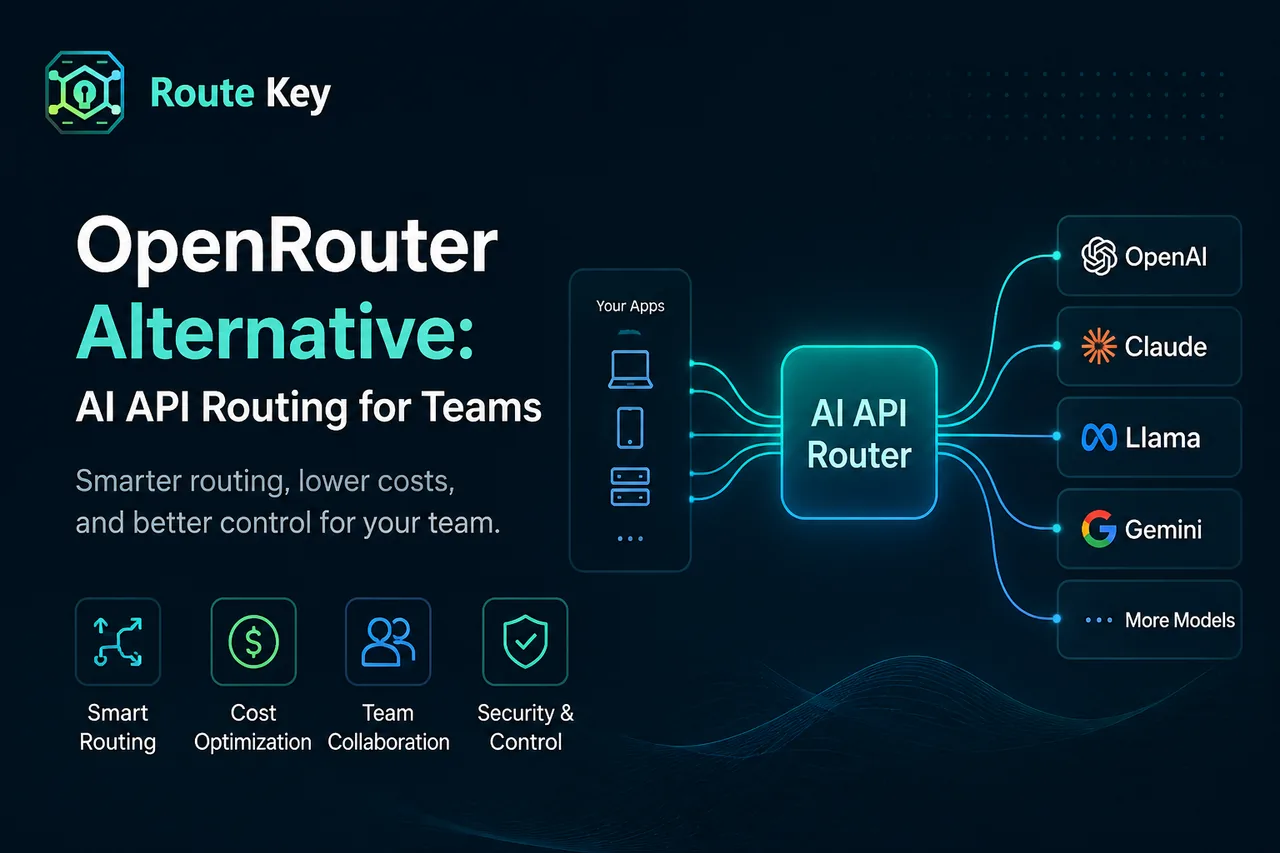
Teams looking for an OpenRouter alternative are usually trying to solve one of two problems: they want one API for several model providers, or they need tighter control over cost, routing, and production operations. OpenRouter is a well-known model discovery and multi-provider API platform. Route Key takes a more operations-focused approach with an OpenAI-compatible gateway, pricing signals, route groups, failover, and usage visibility.
This is a product comparison, not an official partnership or affiliation. Features, model availability, provider routes, and prices change over time. Confirm the current catalog and service terms before moving production traffic.
OpenRouter and Route Key solve related problems
Both services can reduce the work required to connect an application to multiple AI models. Instead of writing a separate integration for every provider, a team can use a compatible API shape, choose a supported model, and keep provider-specific changes behind a gateway.
The emphasis is different:
- OpenRouter is strong at model discovery, provider aggregation, model pages, pricing exploration, benchmarks, and a broad developer documentation network.
- Route Key focuses on an OpenAI-compatible API gateway for model pricing comparison, cost-aware routing, route groups, provider failover, API keys, billing, and Usage Logs.
Neither approach is automatically better for every workload. A developer exploring many models may prioritize catalog breadth and benchmark information. A product team running repeatable traffic may prioritize predictable routing rules, cost signals, usage records, and an operational path for a failed provider.
Compare the important criteria
Model discovery and pricing
OpenRouter exposes a large model directory with pages that describe model IDs, pricing, context length, provider availability, and benchmarks. Its model pages are useful when the first question is, “Which models can I compare?”
Route Key provides a live AI model catalog with model IDs, vendors, endpoints, billing groups, group ratios, and pricing signals. The catalog is designed to answer a more operational question: “Which supported route fits this request and what will it cost through this gateway?”
When comparing prices, use the same model ID and unit. Record input tokens, output tokens, cached input, context requirements, endpoint support, retries, and successful-task cost. A lower token rate is not necessarily a lower production cost if a model needs more retries or longer responses.
OpenAI-compatible integration
The practical value of an OpenRouter alternative depends on migration effort. If your application already uses an OpenAI SDK-compatible request shape, the safest test is usually a configuration change:
- Create a separate development API key.
- Replace the base URL in one environment.
- Select an exact model ID from the live catalog.
- Send a deterministic test request.
- Compare response shape, streaming, tools, latency, tokens, errors, and cost.
Route Key's OpenAI-compatible integration guide covers the API key, base URL, first request, Codex, Claude Code, Gemini CLI, and Cursor. The migration guide adds a staged rollout and rollback checklist.
Compatibility still needs to be tested. Provider-specific parameters, tool schemas, multimodal inputs, reasoning controls, and streaming details can differ even when the basic chat request looks familiar.
Routing and provider failover
A model gateway is more useful in production when it explains what happens after the first request. Before choosing a service, document whether it can expose provider availability, route groups, fallback behavior, endpoint support, and retry outcomes.
Route Key surfaces supported endpoints, groups, group ratios, model availability, request status, latency, token counts, and cost in the Dashboard and Usage Logs. This makes it possible to review a route after a failed or unexpectedly expensive request instead of treating the gateway as a black box.
Do not enable silent model substitution for a workload that requires a pinned model. Define an explicit fallback policy, verify the returned model identifier, and set a quality and cost threshold before shifting more traffic.
Which platform should a team evaluate first?
Choose a broad model marketplace when your main task is discovering providers, comparing a large model catalog, or testing many model families quickly. Choose an operations-focused gateway when you need a stable OpenAI-compatible integration plus cost-aware routing, failover checks, API-key separation, and usage visibility.
The best evaluation is a small production-shaped benchmark. Use representative prompts and measure:
- successful task rate and quality review;
- input, output, and cached token counts;
- time to first token and total latency;
- timeout, retry, and failover frequency;
- cost per successful result;
- the exact model and provider returned.
Keep the benchmark date and model IDs with the result. Model catalogs and provider pricing are living data, so a comparison without a verification date becomes misleading quickly.
A practical Route Key evaluation path
Start with one low-risk service or staging environment. Create a dedicated key, set the Route Key API base URL in the existing SDK configuration, and choose one model from the Models page. Send a normal request before testing streaming, tools, or long context.
Then inspect Usage Logs and compare the observed cost and latency with the current provider. If the result is acceptable, test a second model and an explicit fallback path. Keep the original provider configuration available for rollback until the new route has passed the same quality and reliability checks.
FAQ
Is Route Key an official OpenRouter alternative?
Route Key is an independent AI API gateway. It is not affiliated with OpenRouter. The useful comparison is based on supported capabilities, current model availability, pricing signals, routing behavior, and operational requirements.
Can I move an OpenAI SDK application without rewriting it?
Often, the first test can preserve the SDK request shape and change the base URL, API key, and model ID. Verify authentication, streaming, tools, structured output, multimodal inputs, error handling, and usage accounting before production migration.
Does a gateway always choose the cheapest model?
No. The lowest unit price may not produce the lowest cost per successful task. A useful routing policy considers capability, endpoint, latency, provider availability, retries, cache behavior, and the quality threshold for the workload.
Where can I compare current Route Key model pricing?
Use the Route Key model catalog for current model IDs, vendors, endpoints, groups, and pricing signals. Recheck the catalog before a purchase or production rollout because availability and prices can change.